Website Design
Website Design
Applied Peace Strategies
A peace consultancy in the defense corridor
Updated: May 2026
Applied Peace Strategies spent years operating under the umbrella of George Washington University. When it came time to leave academia and compete for corporate and institutional partnerships in the DC/NOVA GovCon space, they had nothing: no website, no brand system, no way to collect donations online, no marketing infrastructure. They came to me with a Word doc, a simple logo, and a few color recommendations.
Peace and conflict studies has no real presence in the federal and defense technology corridor. AP Strategies wanted to position there, alongside firms building frontier tech and pulling down large contracts. That positioning challenge became the core design problem.
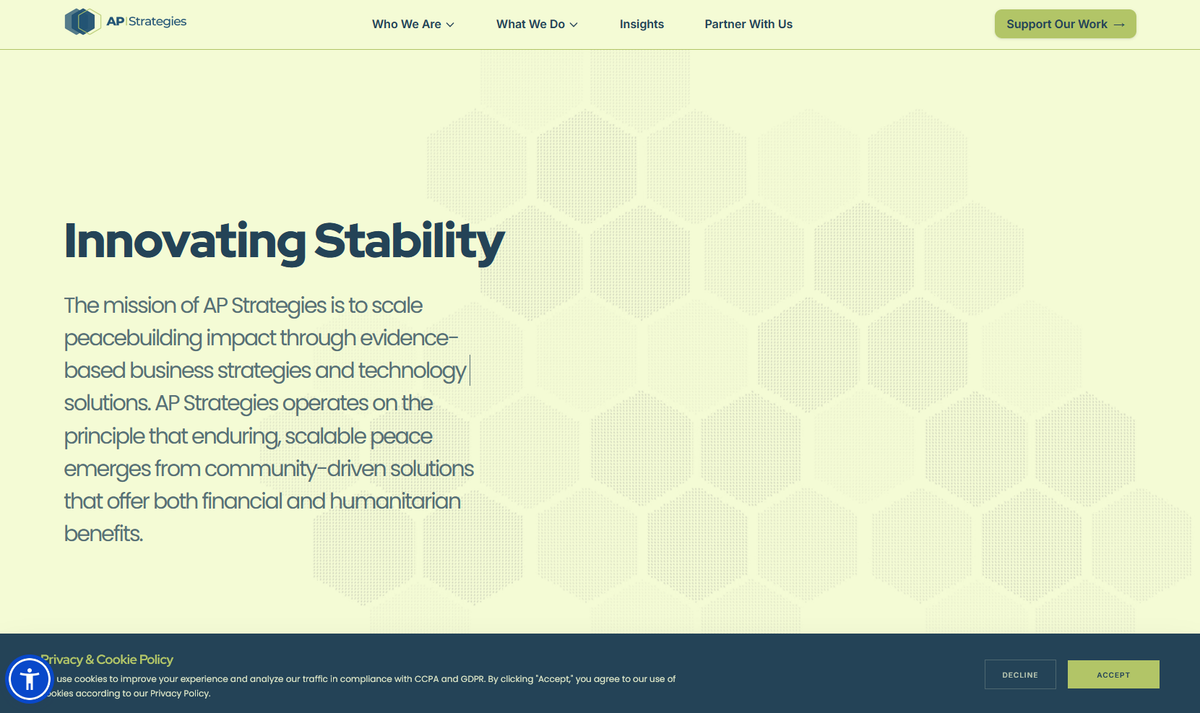
Applied Peace Strategies brand and marketing site
The Positioning Tension
The client knew they wanted to lean toward tech, capital, and "peacetech" solutions. But they were still finding their voice. They are optics-conscious and wanted to position at the intersection of corporate strategy, conflict solutions, and technology. They wanted to be taken seriously by federal partners and defense-adjacent firms while remaining accessible to international NGOs.
My early moodboards pulled from VC websites for frontier markets and defense tech. Clean, confident, capital-forward. The client liked the direction but felt it was too sharp. We pulled back and found a middle ground: premium enough to sit alongside top-tier govcon firms, soft enough to feel like an organization rooted in peace work.
What I Built
I designed in Figma first, built out a full design system, then used Figma MCP with Claude Code to develop the site in VS Code. The stack: React, Tailwind CSS, Vite, hosted and deployed on Vercel.
The site is more than a marketing page. It includes a Sanity.io CMS so the client can manage content independently, GiveButter integration for online donations and fundraising, Formspree for contact and inquiry forms, Google Analytics for traffic tracking, and SEO/AEO optimization for discoverability in both search engines and AI-generated answers.
The work was contributed as workshare, equaling around 145 hours of design & development. No hosting plan existed beyond their GoDaddy domain names. Vercel solved deployment and hosting. Sanity's free tier handled CMS. Every integration was chosen to work at zero cost while scaling if the org grows.
The Invisible Work
The hardest part was not the code. It was taking a Word doc with loose copy and color suggestions and maturing that into a cohesive design system and visual language. Building assets, defining typographic hierarchy, establishing a component library that felt intentional rather than assembled.
Every client deserves their own design system. Not a template. Not something AI-generated and dropped in. Craft, taste, and distinction are table stakes. This needed to look as premium as the sites of top-tier VCs and unicorn defense tech firms, because that's the table AP Strategies wants to sit at.
How I Worked
Designed the full system in Figma: palette, type scale, components, page layouts. Used Figma MCP to bridge design tokens into Claude Code, then developed the frontend in VS Code. Wired up all third-party integrations (Sanity, GiveButter, Formspree, Google Analytics) and handled deployment configuration on Vercel. Worked directly with the client throughout, iterating on positioning and visual tone.
Outcome
The site is live at apstrategies.net. The client has a complete digital presence where none existed before: a content-managed site they can update themselves, a donation pipeline, contact forms, and analytics. They feel positioned to pursue corporate contracting work with confidence, which was the whole point.